
A straight-talking guide for Winnipeg homeowners who are tired of replacing plastic edging every few springs.
| QUICK ANSWER Decorative concrete curbing in Winnipeg typically runs $10 to $18 per linear foot installed, and the season runs from roughly early May to mid-October once the ground has thawed. Whether it survives our winters comes down to two things: a properly compacted base, and control joints cut every three to four feet. Winnipeg’s Red River clay swells and shrinks with moisture, so curbing will move — good installs decide where it cracks, and you never see it. |
Every spring, the same thing happens. The snow finally goes, you walk out to look at the yard, and the black plastic edging you installed three years ago has lifted out of the ground and is curling up out of the mulch like a strip of licorice. The bed line you spent a weekend cutting is gone. The rock has migrated into the grass.
Meanwhile, you’ve driven through Linden Woods or Bridgwater and seen the yards with a clean, continuous concrete border — one unbroken line, holding a crisp curve, sitting exactly where it sat last year and the year before.
That’s decorative concrete curbing. Here’s what it costs in Winnipeg, what it does and doesn’t solve, and the one question that separates an install that lasts twenty years from one that looks rough by year three.
What is decorative concrete curbing?
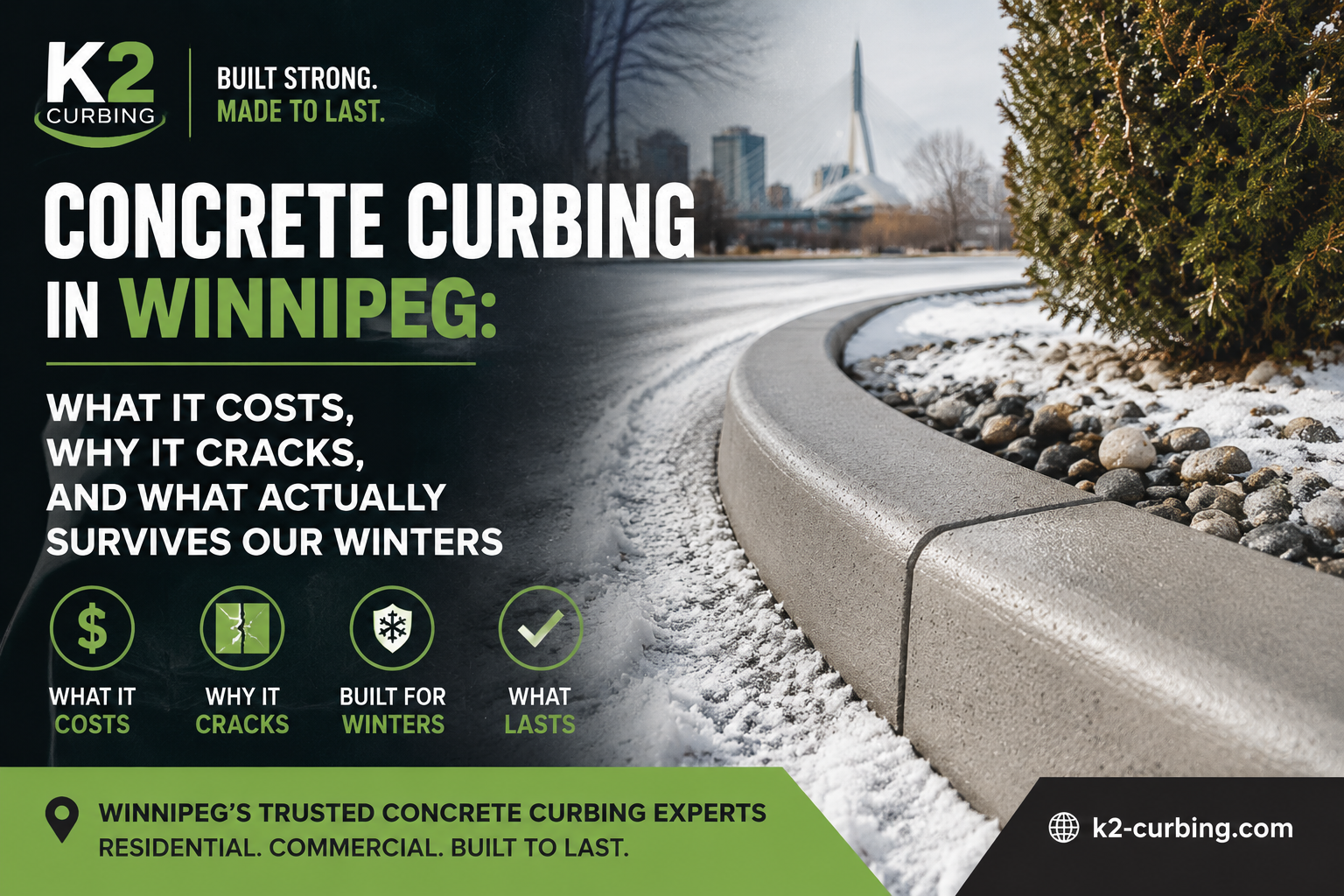
Decorative concrete curbing is a continuous, reinforced concrete border extruded on site by a curb machine. Unlike pavers or blocks, it isn’t assembled from separate units — it’s laid as one continuous piece that follows whatever line you want, including tight curves that would be difficult with brick.
A typical residential curb sits about 4 to 6 inches above grade and 5 to 8 inches wide, with a portion below grade for stability. Profiles vary — a flat mower’s edge lets you run a wheel along it and skip the trimming, while a slant or roll-top profile gives more of a raised, decorative look. It can be integrally coloured and stamped with a pattern, or left plain grey.
Practically, it does three jobs: it holds your mulch or rock in the bed instead of on the lawn, it stops grass and creeping weeds from migrating into planted areas, and it gives the yard a defined line that reads as finished.
Why curbing cracks in Winnipeg — and how good installs prevent it
This is the section most curbing websites skip, and it’s the one that matters here.
Winnipeg is built on Red River clay, which is expansive. It absorbs water and swells, then dries out and shrinks — and the movement is significant, which is why this city has such an active foundation repair industry. Layer on a climate that swings from +30°C in July to -35°C in January, with freeze-thaw cycles in both shoulder seasons, and you have ground that simply does not sit still.
So here’s the honest framing: concrete curbing in Winnipeg will move. Any installer who tells you their product never cracks is either new or not being straight with you. The goal isn’t to prevent movement — it’s to control where the concrete relieves that stress.
That’s what control joints do. While the curb is still green, the installer cuts shallow joints every three to four feet. When the ground shifts, the concrete separates at those joints instead of fracturing randomly across the face. From two feet away, a jointed curb that has moved still looks like a clean, continuous line. An unjointed curb that has moved looks like a broken sidewalk.
The other half is what’s underneath. Sod, topsoil, and organic material have to come out, and the base needs to be compacted before the curb goes down. Curbing laid straight onto soft ground will settle unevenly no matter how good the mix is.
The single best filter question for any Winnipeg installer: “How far apart do you cut your control joints, and how do you prep the base?” A specific answer — three to four feet, sod stripped, base compacted — tells you more than any gallery of freshly poured photos.
Curbing versus every other edging option
If you’re weighing your options, here’s how the common choices actually perform in this climate:
| Edging Type | Typical Lifespan | How It Handles a Winnipeg Winter | Rough Cost |
| Extruded concrete curbing | 20–30 years | Moves with the ground as one piece; jointed correctly, cracks stay hidden | $10–$18 / ft |
| Plastic or poly edging | 3–6 years | Frost heave lifts it out of the ground; goes brittle in deep cold | $2–$5 / ft |
| Steel or aluminum edging | 15–25 years | Holds a line well, but can bend under a plow and rusts at cut edges | $8–$14 / ft |
| Paver or brick border | 20+ years | Individual units shift independently; joints need periodic resetting | $15–$30 / ft |
| Natural stone | Lifetime | Very durable, but stones migrate over years of freeze-thaw | $20–$45 / ft |
| Treated wood | 5–8 years | Absorbs moisture, then warps and rots from the clay side first | $4–$8 / ft |
Cost ranges are general Winnipeg market estimates for planning purposes; confirm current pricing with your installer.
Planning your yard for this season? K2 Curbing installs continuous decorative curbing across Winnipeg and the surrounding municipalities. We’ll measure your beds, walk you through profiles and colours, and give you a written price per linear foot — no guesswork. Book your free on-site quote at k2-curbing.com
How much does concrete curbing cost in Winnipeg?
Expect roughly $10 to $18 per linear foot installed. A standard front garden bed of 60 to 100 feet generally lands between $700 and $1,700, while bordering both sides of a driveway — commonly 100 to 160 feet — runs closer to $1,200 to $2,800.
What moves you within that range:
- Profile and finish — a plain mower’s edge sits at the low end; stamped and coloured work costs more
- Colour and stamping — colour hardener and stamped patterns add material and labour
- Site access — narrow side yards, gates, and slopes slow the machine down
- Total length — most companies have a minimum charge, so a 25-foot job costs more per foot than a 150-foot job
- Removal of existing edging — tearing out old plastic, wood, or broken block edging is usually a separate line
Compared against replacing plastic edging every four or five years plus the weekends spent doing it, curbing generally pays for itself somewhere in the second replacement cycle — and it’s one of the few landscape upgrades that reads immediately from the curb when you sell.
When can curbing be installed in Manitoba?
The Winnipeg season runs from roughly early May through mid-October, though the exact bookends shift each year with the thaw and the first hard frost.
Concrete needs consistent temperatures above about 5°C to cure properly, and the ground has to be thawed enough to prep a base. That’s a short window in a city like ours, and it means the good crews book up fast — June through August fills first.
| Planning your yard for this season? K2 Curbing installs continuous decorative curbing across Winnipeg and the surrounding municipalities. We’ll measure your beds, walk you through profiles and colours, and give you a written price per linear foot — no guesswork. Book your free on-site quote at k2-curbing.com |
Keeping curbing in good shape through winter
Curbing is low-maintenance, not no-maintenance. Three things extend its life considerably:
- Mark the ends with stakes before the first snow so plow operators and shovel crews know exactly where it is. Most curb damage in this city is impact damage, not weather damage.
- Skip the rock salt on or beside the curb. Chlorides eat concrete surfaces and cause scaling. Use sand for traction, or a concrete-safe deicer.
- Reseal every two to three years. Sealing slows moisture absorption, which is exactly what drives freeze-thaw damage at the surface.
How to choose a curbing installer in Winnipeg
Beyond joint spacing and base prep, a short checklist:
- Ask what the warranty actually covers — cracking, settling, and colour fade are three different things, and warranties often cover only one
- Confirm insurance and WCB coverage — anyone working on your property should carry liability insurance and be in good standing with the WCB
- Ask to see a job that’s three to five years old — fresh concrete always photographs well; a curb that has been through four Winnipeg winters tells you the truth
- Get it in writing — quotes should be per linear foot with removal, profile, and colour itemized separately
And ask whether they’ve worked in your specific area. Crews that work regularly in older neighbourhoods like River Heights or St. Vital, where mature tree roots and settled grades complicate the line, will spot problems during the quote rather than on install day.
Frequently asked questions
How much does concrete curbing cost in Winnipeg?
Most residential curbing runs $10 to $18 per linear foot installed. A typical front bed of 60 to 100 feet lands around $700 to $1,700. Profile, colour, stamping, site access, and removal of old edging all affect the final number.
Will concrete curbing crack in a Winnipeg winter?
It can move — Red River clay and freeze-thaw cycles guarantee ground movement. Properly installed curbing has control joints cut every three to four feet, so any separation happens at those joints and stays visually hidden rather than cracking randomly across the face.
When can concrete curbing be installed in Manitoba?
Generally early May through mid-October, once the ground has thawed and temperatures stay reliably above about 5°C for curing. Book quotes in late winter or early spring, since crews fill their June-to-August schedules first.
Is concrete curbing better than plastic edging?
For this climate, yes. Plastic edging typically lasts three to six years before frost heave lifts it out of the ground and cold makes it brittle. Concrete curbing lasts 20 to 30 years and stays where it was installed.
How soon can I put mulch and rock back after installation?
You can usually backfill beds within 24 to 48 hours and walk near the curb the next day. Keep vehicles off it for about a week while the concrete reaches working strength, and hold off on sealing until the installer advises.
Does curbing cause drainage problems in garden beds?
It shouldn’t. Installers cut weep holes or leave deliberate drainage gaps at low points so water moves out of the bed rather than pooling behind the curb. Raise this during the quote if your yard has a known low spot or drainage issue.
| Planning your yard for this season? K2 Curbing installs continuous decorative curbing across Winnipeg and the surrounding municipalities. We’ll measure your beds, walk you through profiles and colours, and give you a written price per linear foot — no guesswork. Book your free on-site quote at k2-curbing.com |